

How to Choose Food Processing Machinery for Your Business

Choosing food processing machinery is not a shopping exercise. It is a production decision that affects product quality, labor, cleaning time, and future growth. A mixer that handles today’s small batches may struggle when demand doubles. A conveyor that saves floor space may complicate washdown. Details matter.

Food engineering scholar R. Paul Singh’s work offers a useful perspective. Paraphrased for this guide, the principle is: “Choose equipment around the product, the process, and the people who operate it.” That is not a verbatim quotation; it captures a practical way to assess food products machinery. Start with the product’s texture, temperature, and handling needs. Then compare capacity, materials, controls, service support, and cleaning requirements. Ask for a demonstration using ingredients similar to yours, not just an empty machine running smoothly. Check whether operators can reach fittings, read controls, and clear routine blockages without awkward workarounds. Small details matter.

Budget deserves a closer look, too. Purchase price is only one part of ownership; installation, energy use, spare parts, and downtime also count. A polished sales presentation can make any machine look simple. Real production is less tidy. This guide explains how to define your needs, compare equipment types, assess suppliers, and avoid common buying mistakes. It also leaves room for an uncomfortable question: are you buying the right machine, or merely the one that fits your current layout?
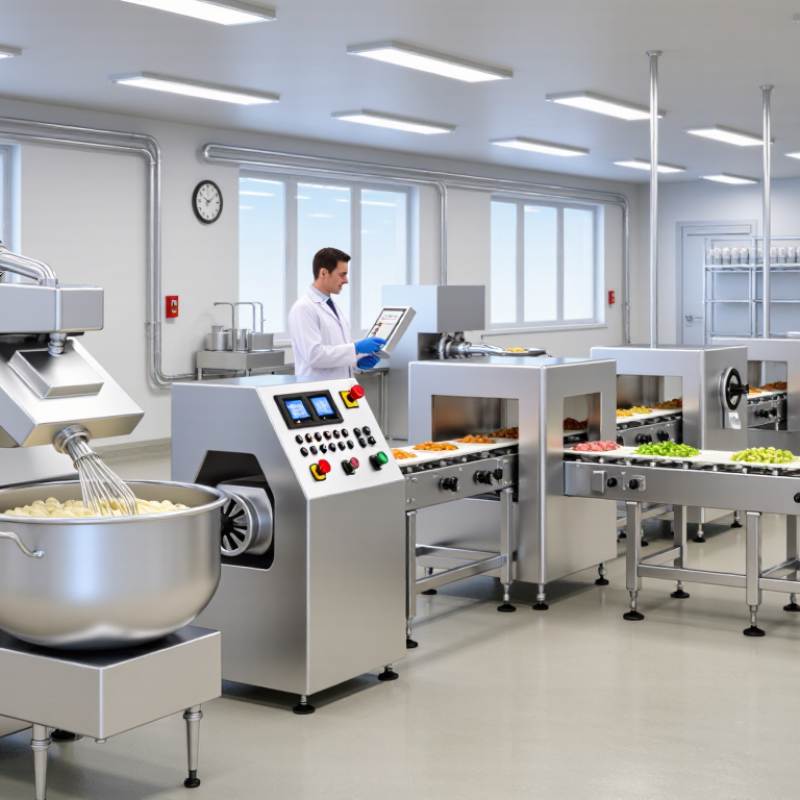
How to Choose Food Processing Machinery for Your Business

Define Your Production Requirements and Processing Goals

Before comparing machinery, define what the line must produce on an ordinary day, not just during a perfect test run. Record target kilograms per hour, batch size, operating shifts, and expected seasonal peaks. Then map each step: washing, cutting, heating, filling, and cleaning. A cooker rated for your target volume may still create a bottleneck if the filler runs slower. Check product details too. Thick sauces, delicate berries, and leafy greens need different handling. Note temperature limits, particle size, moisture, and acceptable yield loss.

Set measurable processing goals, such as consistent texture, shorter changeovers, or less product left in pipes and tanks. The FAO’s 2023 report on food and agriculture-related Sustainable Development Goals estimated that 13.2% of food was lost between harvest and retail in 2021. That global figure does not predict one factory’s losses, but it makes yield worth measuring. Weigh raw inputs and saleable output during representative runs. Include cleaning and changeover time in capacity calculations; brochures rarely make those interruptions feel real. Small details matter.

I would not rely on one “maximum capacity” number. Ask for performance under your actual product conditions, and test a sample where possible. A planning estimate can still be wrong. Leave room for maintenance, future products, and uneven supply, while checking whether added capacity would simply move the bottleneck downstream.

Map Each Stage of Your Food Production Process

Map the full production route before comparing machines. Start with receiving, where ingredients arrive in bins, chilled totes, or dry sacks. Note their condition, temperature, and daily volume. Then trace washing, sorting, cutting, cooking, cooling, filling, and packing. Not every product needs every step, but skipped steps can hide costly gaps.

For each stage, record the required output and what enters or leaves the machine. A vegetable line may need a washer that handles leafy greens gently, followed by a cutter sized for the actual batch rate. Check contact surfaces, cleaning access, drainage, and changeover time. Small details matter. A machine rated for high output can still slow the line if its discharge does not match the next conveyor.

Map utilities and people, too. Measure floor space, doorways, water supply, power, ventilation, and operator access. Leave room to revise. Production plans are often tidier on paper than on a wet, busy floor. Walk the route with operators and maintenance staff; they may spot awkward lifts, splash zones, or frequent adjustments that a layout misses. Use trial runs and measured cycle times to confirm assumptions before committing. Revisit the map when recipes, package sizes, or daily volumes change.

Match Machinery Types to Products and Operations

Choose machinery by the product’s texture, moisture, and fragility, not just its name. Firm carrots can handle abrasive washing and slicing; ripe berries need gentler conveying and careful grading. Small details matter. A sticky dough may need a different mixer and discharge design than a dry flour blend. Match each machine to the actual product, including its temperature and particle size.

The FAO’s 2024 tracking report estimated that 13.2% of food was lost globally between harvest and retail in 2021. For produce lines, washing, sorting, and cooling equipment should suit the crop’s condition and the time available before processing. UNEP’s Food Waste Index Report 2024 estimated 1.05 billion tonnes of food waste in 2022. That figure covers retail, food service, and households, not factory losses, but it reinforces the value of measuring trim and rejected product. Specify yield checks where they matter.

Map the full operation before buying: hourly throughput, batch size, cleaning routine, floor space, and changeover frequency. Test it wet. A line that runs smoothly with a dry sample may clog when ingredients are cold or sticky. Ask suppliers for trials using your own product and record output, waste, and cleaning time. A capacity estimate can still be wrong; allow room for seasonal variation and future adjustments.

How to Choose Food Processing Machinery for Your Business — Match Machinery Types to Products and Operations

Product or Process Suitable Machinery Main Operation Key Selection Factors Hygiene and Handling Considerations
Fresh fruits and vegetables Sorting and inspection conveyor, washer, peeler, slicer or dicer Remove soil and damaged material; prepare produce to a consistent cut size Consider produce type, fragility, required cut shape, water use, and the amount of manual inspection needed. Choose equipment with accessible product-contact surfaces and a cleaning approach suitable for wet processing.
Meat and poultry Grinder, mixer, portioner, forming machine, or slicer Reduce size, blend ingredients, form portions, or slice cooked and chilled products Match the machine to the product’s temperature, texture, bone content, batch size, and required portion consistency. Plan for thorough cleaning and separation of raw and ready-to-eat product operations.
Grains and flour Cleaner, de-stoner, mill, sifter, or mixer Remove foreign material, reduce particle size, separate fractions, and blend ingredients Check grain type, target particle size, desired flour characteristics, dust control, and upstream storage and conveying. Use suitable dust-management measures and provide access for inspection and cleaning.
Dairy products and liquid foods Storage tank, pump, filter, heat exchanger, homogenizer, or filling machine Transfer, filter, heat-treat, homogenize, or package liquids and semi-liquids Match equipment to viscosity, temperature, flow requirements, product sensitivity, and the intended process sequence. Evaluate clean-in-place compatibility, drainability, seals, and hygienic connections for product-contact systems.
Bakery dough and batters Planetary or spiral mixer, divider, rounder, sheeter, or depositor Mix ingredients and portion or shape dough and batter Consider dough hydration, batch size, mixing intensity, product shape, and whether recipes require gentle or intensive handling. Check that contact surfaces can be cleaned effectively, especially around mixing tools, rollers, and dosing components.
Sauces, soups, and prepared foods Jacketed kettle, agitator, blender, pump, or filling machine Heat, mix, blend, transfer, and fill liquid or particulate products Assess viscosity, particle size, heating method, agitation needs, batch volume, and filling accuracy requirements. Confirm that the equipment can be cleaned for the ingredients used and that product does not collect in hard-to-reach areas.
Snack foods and fried products Depositor or former, fryer, de-oiling conveyor, seasoning tumbler, or packaging machine Form, fry, remove excess surface oil, season, and package products Match equipment to product shape, cooking time, oil-management plan, seasoning method, and packaging format. Include safe access for oil handling and cleaning, along with appropriate temperature controls and guarding.
Frozen foods Blancher or cooker where required, conveyor freezer, and packaging machine Prepare products for freezing, freeze them, and package them for storage or distribution Consider product size, target product temperature, freezing method, line layout, and the capacity of the cold-storage system. Plan for condensation, frost management, cleanability, and materials suitable for the operating temperature.
Packaged products across categories Weigher, filler, sealer, labeler, checkweigher, or metal detector Measure, fill, close, identify, and inspect finished packages Choose based on product form, package material and format, target line speed, fill accuracy, and inspection requirements. Ensure product-contact parts suit the food and cleaning method; verify that inspection equipment fits the product and package.

Assess Capacity, Materials, Safety, and Compliance

Choosing food processing machinery starts with real capacity, not a supplier’s headline figure. Record your peak hourly demand, product size, and changeover time. Then compare them with the machine’s rated output under similar conditions. A line that runs too slowly creates queues; one that runs too fast may damage delicate products. Leave room for cleaning and maintenance. The margin may feel wasteful, but seasonal demand can expose a tight plan.

Materials matter at every product-contact point. Check whether surfaces resist corrosion, tolerate your cleaning chemicals, and allow access to seams, drains, and gaskets. Ask for material certificates and clear cleaning instructions. FAO’s 2019 State of Food and Agriculture estimated that 14% of food is lost between harvest and retail. Better-controlled processing can help reduce avoidable losses, though machinery alone cannot solve them. Test with your actual ingredients; a sample run may reveal sticking, foaming, or breakage.

Safety and compliance need equal attention. Look for fixed guards, accessible emergency stops, and safe procedures for clearing jams. Review food-contact documentation, electrical safeguards, and cleaning records against the requirements that apply in your market. The WHO’s 2015 foodborne-disease estimates attributed 600 million illnesses and 420,000 deaths annually to contaminated food worldwide. Those figures make hygienic design more than a paperwork issue. A checklist helps, but it can miss awkward corners. Inspect the equipment in person, and document what still needs improvement.

Compare Suppliers, Costs, and Long-Term Support

Compare machinery suppliers on more than purchase price. PMMI’s 2023 State of the Industry report put U.S. packaging machinery shipments at $10.2 billion in 2022. The figure signals a substantial market, not a price guide for your line. Ask for an itemized quote covering installation, training, change parts, freight, and commissioning. Request references from plants with similar products, sanitation routines, and daily throughput. Then ask how quickly technicians respond and which parts are stocked locally. Get service response times and spare-part commitments in writing. A polished demo is not proof of reliable support.

Long-term service can outweigh a small discount. Siemens’ 2024 True Cost of Downtime report found that downtime can cost large industrial firms up to 11% of annual revenue. This is a broad industrial benchmark, not a food-factory estimate. Use it as a warning, not a forecast. Compare maintenance schedules, remote diagnostics, refresher training, and wear-part delivery times. Ask for a sample service log, and clarify charges for travel or after-hours calls. Model ownership costs over several years, including energy, cleaning time, yield losses, and planned shutdowns. The spreadsheet may still miss things. Check its assumptions with operators and maintenance staff before signing.