

Best Food Making Machinery Manufacturers in China

China has become a major source of food processing equipment for factories worldwide. Its manufacturers produce machines for mixing, cutting, filling, baking, drying, and packaging. This guide examines the best food making machinery manufacturers in China through practical purchasing criteria. It focuses on engineering quality, production experience, service capacity, and documented reliability.

A capable manufacturer should explain machine capacity with clear figures. Buyers need details about stainless steel grades, motor brands, control systems, and cleaning access. Factory videos can help, but an in-person audit provides stronger evidence. Watch the machine run with real ingredients. Observe noise, product consistency, changeover time, and operator safety. Details matter. Certifications can support trust, yet they should match the actual model and destination market.

The strongest suppliers usually offer testing, installation guidance, spare parts, and responsive technical support. Their engineers should understand temperature control, hygiene design, production flow, and maintenance planning. Performance varies. A low purchase price may hide expensive downtime or difficult cleaning. Some brochures also promise more than ordinary factory conditions can deliver. That deserves careful questioning. Buyers should request sample products, production references, warranty terms, and a complete quotation. No ranking can fit every factory. A small bakery may need a flexible line, while a large producer requires automation and stable output. This overview aims to provide balanced direction, while recognizing that final decisions depend on ingredients, budget, workforce, and local compliance requirements.
Best Food Making Machinery Manufacturers in China

What Defines a Food Making Machinery Manufacturer in China

A food making machinery manufacturer in China is more than a factory with stainless steel equipment. It should understand washing, cutting, mixing, cooking, filling, and packing processes. Experienced teams study product texture, temperature, moisture, and production speed before suggesting a machine. They also provide drawings, test runs, installation guidance, and operator training. Practical experience matters here. A polished brochure cannot replace a clean factory trial.

Tips: Ask for material certificates, process videos, maintenance schedules, and sample testing records. Check whether the supplier can trace key components and explain quality inspections clearly. Reliable manufacturers usually discuss limitations instead of promising perfect results. That honesty is useful.

Professional manufacturers control welding quality, surface finishing, electrical safety, and sanitation design. Food-contact parts should be selected carefully and documented. A dependable supplier also checks machine performance under realistic workloads, not only during a short demonstration. Ask how the equipment handles sticky mixtures, uneven ingredients, or frequent cleaning. These details reveal engineering depth.

No manufacturer gets every decision right. A suitable machine may still need adjustments after installation. Production conditions change, and early assumptions can prove incomplete. Strong suppliers respond with measured troubleshooting, replacement guidance, and clear records. Their authority comes from repeatable work, qualified technicians, and transparent communication. Reliability is built over time, batch by batch.

Key Types of Food Making Machinery and Their Applications

Food making machinery covers several distinct operations, and each requires a different engineering approach. Cutting and slicing machines prepare vegetables, meat, and fruit with consistent dimensions. Mixing and kneading systems create uniform dough, sauces, or fillings. Steamers, fryers, ovens, and retorts then control heat, moisture, and texture. A small temperature error can change the final product.

Filling and sealing equipment supports liquids, powders, and ready-to-eat foods. Weighing systems improve portion accuracy, while metal detectors and checkweighers strengthen quality control. FAO’s 2019 State of Food and Agriculture estimates that about 14% of food is lost before retail. Better dosing, cooling, and processing equipment can reduce some of this loss. However, machine speed alone is not enough.

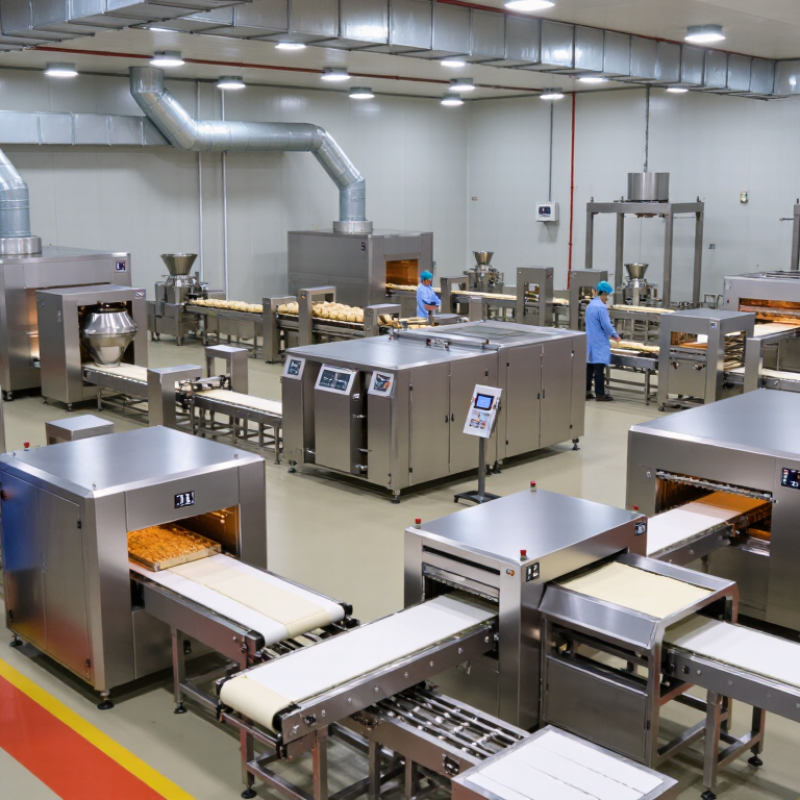
Chinese manufacturers often provide modular lines for bakeries, snack plants, beverage facilities, and frozen-food processors. Buyers should examine stainless-steel grades, cleaning access, control-system records, spare-part availability, and verified production capacity. Factory acceptance tests matter. Ask for samples using the actual raw materials, not only demonstration products. UNEP’s Food Waste Index 2024 reports that 1.05 billion tonnes of food were wasted in 2022. This figure makes efficient machinery valuable, but specifications can still mislead. A highly automated line may increase waste when operators lack training. The practical choice is usually balanced, not simply faster.

How Chinese Manufacturers Design and Produce Food Machinery

Best Food Making Machinery Manufacturers in China

Chinese food machinery manufacturers often begin with the product, not the machine. Engineers study viscosity, temperature, particle size, and cleaning needs. A sauce line may require gentle pumping, while dough equipment needs controlled pressure. These details shape the layout, motor selection, and material choice.

Design teams usually create three-dimensional drawings before cutting metal. Food-contact areas commonly use stainless steel with smooth, easy-to-clean surfaces. Welds are polished to reduce residue buildup. Guards, drains, sensors, and emergency stops are planned during this stage. Some factories also build a small trial unit. It can expose problems early.

Production requires more than assembly. Skilled workers check frame dimensions, shaft alignment, electrical wiring, and surface finishing. Each key component should have inspection records. Test runs may measure output, noise, temperature, and power use. Cleaning trials are equally important. A machine that performs well but hides product remains needs redesign. That mistake still happens.

Reliable manufacturers document changes carefully. They provide operating manuals, spare-part lists, maintenance guidance, and factory test results. Buyers can request material certificates and witness performance testing before shipment. Installation support also matters, especially when the equipment joins an existing line. Practical experience helps engineers adjust conveyors, filling heights, and control settings on site. Not every design is perfect at the first attempt. Honest revision often creates the safer, more durable machine.

Quality Standards, Certifications, and Safety Requirements

Best Food Making Machinery Manufacturers in China: Quality Standards, Certifications, and Safety Requirements

Choosing food-making machinery in China requires more than comparing prices and output figures. Reliable manufacturers document material grades, welding methods, surface finishes, and cleaning procedures. Stainless steel parts should suit food contact applications and resist corrosion. Production records should also support traceability from raw material to final assembly. ISO 9001 can indicate a controlled quality system, but it does not guarantee perfect machinery.

Safety compliance needs careful checking. Depending on the destination market, machines may require CE marking, electrical safety tests, and conformity documentation. Manufacturers should provide guarded moving parts, emergency stops, overload protection, and clear operating instructions. For hygienic production, buyers should review HACCP or ISO 22000 practices within the factory and equipment design. Ask for factory acceptance testing with real ingredients, not only an empty-machine demonstration. Small details matter.

Tips: Request drawings, risk assessments, test reports, and spare-parts lists before ordering. Inspect welds, corners, seals, and drainage points during a factory visit. Confirm whether certificates cover the exact model. A certificate alone is not enough. No audit is perfect. Even experienced buyers can overlook cleaning access beneath conveyors or inside filling valves. Leave time for corrective actions, retesting, and operator training. This practical discipline helps separate dependable machinery manufacturers from suppliers who only present attractive paperwork.

Best Food Making Machinery Manufacturers in China - Quality Standards, Certifications, and Safety Requirements

Evaluation Dimension Applicable Standard or Requirement Relevant Machinery Scope Evidence to Request from a Manufacturer Practical Verification Point
Quality management ISO 9001:2015 quality management system All food-processing and packaging machinery Valid certificate, certification scope, issuing certification body, and surveillance status Confirm that the certificate covers the manufacture or servicing of machinery, not an unrelated business activity
Food-contact materials China GB 4806 series; applicable EU or US food-contact rules when exporting Product-contact surfaces, hoppers, pipes, pumps, valves, seals, belts, and fittings Material declarations, migration-test reports, grade specifications, and supplier traceability records Check that the exact material grade and component are covered by the test report
Stainless-steel construction Hygienic-design principles and the specified food-contact material requirements Mixers, fillers, slicers, conveyors, cookers, tanks, and packaging equipment Material certificates identifying the stainless-steel grade and surface-finish specification Verify smooth, cleanable surfaces; avoid exposed corrosion, product traps, and unsuitable porous finishes
Hygienic design EN 1672-2 principles for food-processing machinery and applicable hygienic-design guidance Equipment exposed to raw materials, ingredients, finished food, or washdown conditions Hygienic-design assessment, cleaning procedure, drainage details, and access information Look for minimized dead spaces, hygienic welds, self-draining areas, and tool-free access where appropriate
Machine risk assessment ISO 12100:2010, Safety of machinery—Risk assessment and risk reduction Cutters, grinders, mixers, conveyors, forming machines, and automated lines Documented risk assessment, protective-measure list, and residual-risk information Ensure hazards such as crushing, cutting, entanglement, burns, noise, and unexpected start-up are addressed
Safety-related controls ISO 13849-1:2023 or IEC 62061:2021, as applicable to the control system Guard interlocks, emergency stops, light curtains, safety relays, and automated production lines Safety-function list, required performance level or safety-integrity calculation, and validation records Test every safety function during factory acceptance testing and site commissioning
Electrical safety IEC 60204-1:2016+A1:2021, Safety of machinery—Electrical equipment of machines Electrically powered machines and integrated production lines Electrical schematics, wiring list, protective-earth test results, insulation test results, and control-panel documentation Check labeling, disconnecting means, grounding, enclosure protection, and compatibility with the destination voltage
China food-machinery safety GB 16798-2010, Safety and sanitation requirements for food machinery Food-processing machinery manufactured for the Chinese market Compliance documentation, technical drawings, sanitation specifications, and inspection records Confirm that product-contact areas, lubricants, drainage, guarding, and cleaning provisions meet the intended application
Export conformity for the European Union CE-marking requirements, applicable EU legislation, harmonized standards, and technical-file obligations Machinery exported to the European Economic Area EU Declaration of Conformity, risk assessment, technical documentation, user instructions, and CE label details Check the applicable legal framework and transition date; do not treat a CE logo alone as proof of compliance
Food-safety management ISO 22000:2018, when the manufacturer operates a food-safety management system relevant to its activities Manufacturers that also handle food, ingredients, hygienic assembly, or validated sanitation processes Certificate scope, prerequisite programs, sanitation controls, and hazard-control procedures Treat ISO 22000 as a food-safety management credential, not as a substitute for machine-safety compliance
Factory acceptance testing Customer-approved FAT protocol based on the purchase specification and applicable safety requirements Complete machines and integrated processing or packaging lines FAT checklist, test videos or records, calibration certificates, punch list, and corrective-action report Test capacity, product-contact cleanliness, dimensions, utilities, alarms, guarding, emergency stops, and changeover time
Traceability and documentation Document-control and traceability practices consistent with the selected quality-management system All machinery, spare parts, and safety-critical components Serial-number records, bills of materials, revision-controlled drawings, manuals, spare-parts lists, and maintenance schedules Confirm that manuals and drawings match the delivered machine configuration and software version
After-sales service Contract-defined response, warranty, training, spare-parts, and remote-support requirements Custom machinery, complete lines, and equipment requiring commissioning Service-level agreement, warranty terms, commissioning plan, training materials, and spare-parts availability statement Evaluate response times, technician coverage, language support, software backup, and availability of critical wear parts

Note: Certification and conformity requirements depend on the machine type, destination market, food-contact application, and project specification. Certificates should always be verified for validity, scope, issuing body, and the exact delivered equipment.

How to Select the Best Chinese Food Machinery Manufacturer

Best Food Making Machinery Manufacturers in China

Selecting among the best food making machinery manufacturers in China requires more than comparing prices. Define your product, output target, ingredients, and available floor space. A capable manufacturer should explain how the machine handles heat, moisture, oil, and cleaning chemicals. Request drawings, utility requirements, and a realistic production test. Watch the test closely. Does the dough feed evenly? Are awkward corners easy to reach?

Check the frame material, welding quality, electrical components, and food-contact surfaces. Ask for material certificates, inspection records, and documents required in your destination market. Certifications matter, but they do not replace practical evidence. Request sample runs using your actual ingredients. Measure output, product weight, temperature, noise, and cleaning time. A factory audit can reveal useful details, such as spare-part storage and technician training.

Reliability also depends on communication after delivery. Confirm installation support, warranty limits, response times, and replacement-part availability in writing. Speak with existing users, if possible, and ask about delays or hidden maintenance costs. One overlooked drain or difficult seal can create daily trouble. No supplier gets every detail right. I would record these weaknesses instead of accepting polished presentations. A manufacturer willing to discuss failures may deserve more trust than one promising perfection. Test acceptance should include clear standards, photographs, and signed results before final payment.

How to Select the Best Chinese Food Machinery Manufacturer

Recommended procurement weighting for evaluating food machinery manufacturers. The scorecard focuses on practical factors such as food-contact safety, customization capability, after-sales support, and total operating value.

Use these weights as a starting point, then verify certifications, machine trials, production capacity, spare-parts availability, and service response before placing an order.