

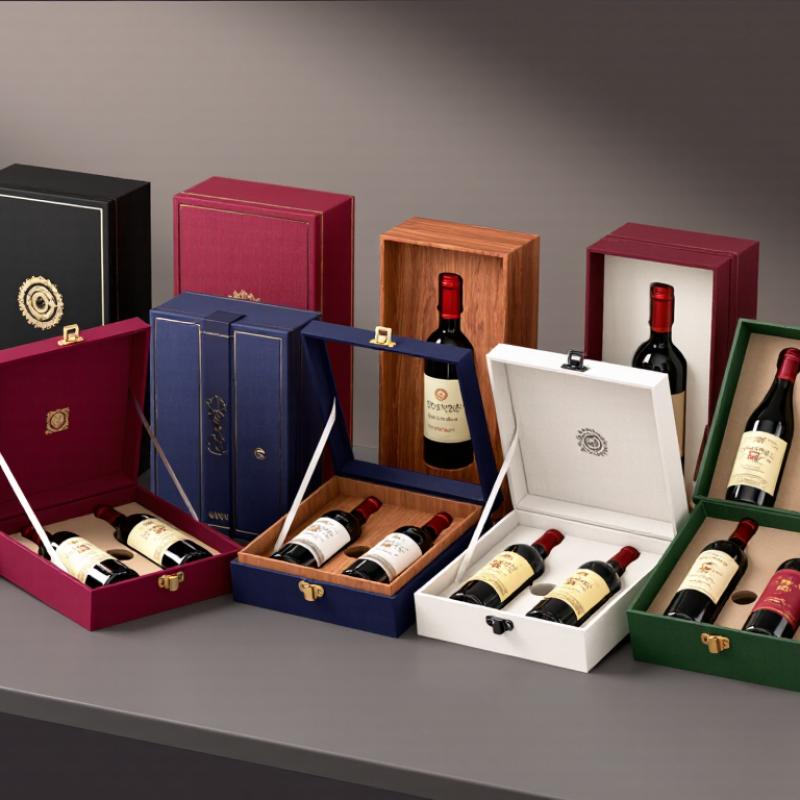
China’s top wine bottle gift box manufacturers serve brands seeking packaging that feels considered before a bottle is opened. A strong box must do more than look polished. It should hold the bottle securely, open without fuss, and present details such as foil stamping, textured paper, or a fitted insert with care. Wine Bottle Gift Boxes also vary widely in materials, finishes, order quantities, and customization options. Those differences can matter more than a striking product photo.
Industrial designer Dieter Rams offered a useful design principle: “Good design is as little design as possible.” He is not a wine-box specialist, but the principle applies well here: decoration should support the bottle, not overwhelm it. Buyers comparing Chinese suppliers can ask for material specifications, structural samples, production timelines, and clear pricing for custom work. A sample is revealing. Does the insert keep the bottle steady? Do the corners arrive clean and firm? Small flaws can become obvious when a box is held in the hand.
This guide introduces ten manufacturers and considers their product focus, customization, and practical fit for different buyers. It is a starting point, not a final verdict. Supplier capabilities and service can change, and the best-looking option may not be the most reliable one. Check details directly, and leave room for a little doubt before placing a large order.
China Top 10 Wine Bottle Gift Box Manufacturers
Wine Bottle Gift Box Manufacturing in China: Industry Overview
China’s wine gift-box sector sits within a broad, fast-moving packaging industry. China Packaging Federation’s 2023 industry statistics report operating revenue of about 1.154 trillion yuan among packaging enterprises above the designated size threshold. Paper and paperboard packaging containers generated about 286.2 billion yuan. These figures provide useful context, but they do not isolate wine boxes. Treat them as indicators of manufacturing scale, not proof of demand for any specific box type.
Production quality depends on details buyers can inspect. A rigid box needs clean edges, even wrapping paper, and corners that resist crushing during handling. Bottle inserts should hold glass securely without excessive force. Moisture and temperature changes can also affect board strength and adhesive performance. Ask suppliers for material specifications, a physical pre-production sample, and packing tests using the intended bottle dimensions. Small checks matter.
Finishes such as foil stamping, embossing, and magnetic closures can improve presentation, but each adds cost and production steps. Compare samples under natural light; printed colors may shift between proof and finished runs. A polished sample can still conceal a weak corner. That part deserves a closer look. Since public industry data rarely separate wine gift boxes from other paper packaging, supplier-level evidence remains important: inspect tolerances, repeat-order consistency, and protective packaging before committing to volume.
Wine gift-box dimensions are designed around the bottle format being packed. These examples show common nominal capacities; bottle proportions and format names can vary by region and producer.
Choosing a leading wine gift box manufacturer requires more than comparing glossy product photos.
Start with material specifications: board grade, thickness, surface finish, and insert composition. Ask for a physical sample and check whether the bottle sits firmly without pressure on the neck. Small details matter. Hinges should open smoothly, edges should remain square, and magnetic closures should align after repeated use. A supplier should explain how color proofs are approved and how print variation is measured between batches. A polished catalog is not evidence of consistent production.
Review quality controls as well as design. Request documented inspection points for cutting, lamination, assembly, and final packing, then ask how defects are recorded and corrected. Confirm production capacity against your order size and seasonal schedule; maximum output means little when lead times are unclear. Check whether the factory can provide carton dimensions, drop-test details, and protective packing plans for shipment. Clear answers matter. Communication is also a criterion: technical questions should receive specific replies, not only sales language. Some criteria are difficult to verify remotely, so arrange an independent audit or third-party sample check when justified by order value. Even then, no checklist removes every risk; that is worth admitting.
Profiles of 10 Wine Bottle Gift Box Manufacturers
These capability-based profiles help buyers compare Chinese wine-box suppliers without treating them as verified company endorsements. The OIV’s State of the World Vine and Wine Sector in 2023 estimated global wine production at 237 million hectolitres. The China Paper Association reported 144.05 million tonnes of paper and paperboard production in 2023. Those figures show the scale of the wine and paper sectors, but do not prove any factory’s quality.
Profile 1: A rigid-box maker offering wrapped paperboard and clean corners. Profile 2: A folding-carton specialist suited to lighter gift packaging. Profile 3: A supplier focused on textured papers and restrained foil accents. Profile 4: A producer with molded-pulp inserts for bottle protection. Profile 5: A wood-box workshop serving premium, heavier formats. Profile 6: A small-batch shop useful for trial orders. Profile 7: A large-volume factory emphasizing repeatable dimensions. Profile 8: A custom-print supplier able to match colors across components. Profile 9: A maker offering magnetic closures and fitted interiors. Profile 10: An export-oriented supplier experienced with flat-packed designs.
Details matter. Buyers should request physical samples, board thickness, insert measurements, and packaging-test results. Ask how color variation and damaged units are handled. A polished sample can hide weak hinges or loose inserts. Some specifications still need checking against the actual bottle, especially shoulder width and total weight.
Industry overview: The entries below describe common wine gift-box manufacturing specializations and packaging options, not verified profiles of named suppliers. Materials, finishes, protection, and customization vary by factory and should be confirmed directly before ordering.
| Profile | Typical specialization | Common box structure | Common materials | Bottle protection | Common customization | Typical application |
|---|---|---|---|---|---|---|
| Profile 01 | Rigid presentation boxes | Lift-off lid or book-style box | Rigid paperboard wrapped in printed or textured paper | Fitted paperboard or foam insert, selected to suit bottle dimensions | Printing, foil stamping, embossing, and insert layout | Premium single-bottle gifting |
| Profile 02 | Folding carton packaging | Die-cut folding carton with tuck or crash-lock bottom | Folding boxboard or coated paperboard | Internal divider or shaped board insert, where required | Full-color printing, coatings, windows, and structural die-cuts | Retail-ready gift packaging |
| Profile 03 | Corrugated protective gift boxes | One-piece or multi-piece corrugated carton | Corrugated fiberboard with printed outer liner options | Corrugated partitions or fitted cushioning components | Printed graphics, dividers, and custom die-cut layouts | Shipping and gifting where added transit protection is needed |
| Profile 04 | Wooden presentation cases | Hinged-lid or sliding-lid case | Wood or wood-based panels with optional paper or fabric lining | Shaped interior support or lined compartment | Surface engraving, printed panels, hardware, and interior layout | Keepsake and corporate gift sets |
| Profile 05 | Multi-bottle gift packaging | Two-bottle or multi-bottle box with divider | Paperboard, rigid board, or corrugated board | Individual compartments to separate bottles | Compartment count, handle, printed sleeve, and surface finish | Paired wines, tasting sets, and holiday bundles |
| Profile 06 | Eco-conscious paper packaging | Folding carton or paper-based rigid box | Paper-based materials; recycled content is subject to specification | Paperboard cradle or divider designed for the bottle format | Paper stocks, low-plastic design choices, and print finishes | Brands seeking paper-focused gift packaging |
| Profile 07 | Gift boxes with accessories | Presentation box with separate accessory compartments | Rigid board or folding paperboard with fitted inserts | Bottle compartment plus separate spaces for accessories | Insert layout for items such as a stopper, opener, or pourer | Ready-to-gift wine and accessory sets |
| Profile 08 | Luxury-finish paper boxes | Rigid box or folding carton with decorative exterior | Paperboard with specialty papers or laminated surfaces | Custom-fitted insert, subject to bottle size and weight | Foil stamping, embossing, debossing, and matte or gloss coating | Special-occasion and premium retail presentation |
| Profile 09 | Window-display gift boxes | Folding carton or rigid box with a viewing window | Paperboard with a clear window film where specified | Internal support to limit bottle movement inside the box | Window shape, printed graphics, and insert design | Display-led retail gifting |
| Profile 10 | Custom-shaped and novelty boxes | Custom die-cut or assembled presentation structure | Paperboard, rigid board, or a combination of packaging materials | Structure-specific insert or internal support | Shape, opening style, print, and insert configuration | Campaigns, seasonal packaging, and distinctive gift presentations |
When comparing China’s top 10 wine bottle gift box manufacturers, look beyond sample photos. Ask which materials they can source consistently, such as corrugated board, greyboard, paper wrap, or molded pulp inserts. Request a physical sample with the intended bottle size. Fit matters. A loose insert can let glass shift during handling, while an overly tight one may make unpacking awkward.
Design options often include hinged lids, magnetic closures, drawer-style boxes, and window panels. Finishes such as foil stamping, embossing, and matte lamination can add texture, but each choice affects cost and production time. Check whether the manufacturer can match colors across repeat orders and provide a clear proof before bulk production. A rigid box can feel substantial, but it may add shipping weight; that trade-off is easy to underestimate. Small details matter.
Tips: Share bottle dimensions, target order quantity, and delivery schedule when requesting a quote. Ask for insert material details, sample lead time, and quality checks. If a supplier promises every finish quickly, ask how that timeline was tested. A little doubt is useful.
Choosing a China-based wine bottle gift box manufacturer means checking production control, not just attractive catalog photos. Ask for a sample made for your bottle’s exact height, shoulder, and base diameter. Small fit errors can let glass shift inside a rigid box. Request details on insert materials, board thickness, print tolerances, and inspection criteria. Check whether finished packs are tested for compression, vibration, and drops. A tidy prototype is not proof of safe transit. Ask for test records, batch traceability, defect limits, and a clear remedy process. Get an itemized quote covering tooling, sampling, packaging, and freight. Confirm the minimum order quantity and realistic lead times in writing.
Sustainability also deserves evidence, not green wording. Trivium Packaging’s 2023 Global Buying Green Report found that 82% of surveyed consumers were willing to pay more for sustainable packaging. That is broad consumer research, not a guarantee about wine-box buyers. Ask manufacturers to identify paper sources, recycled content, coatings, and whether components separate easily for recycling. Request supporting documents instead of relying on a leaf icon. Compare samples after humidity exposure; paper can soften, and finishes may scuff. One imperfect point: sustainable materials can raise costs or limit decoration. Ask for a lower-impact option alongside the premium finish, then compare several units for consistency.
